Friday, February 25, 2011

THE BENDER


February, 26th 2011

It's the bleak part of winter. The holidays have come and gone. Spray tanning has lost it's luster. It's cold and gray. We will be reliving the same exact cold and gray day for another 3 months. The long haul of winter is in front of us. From a meteorological standpoint, February in Portland is a straight and unremarkable road with no horizon, no beautiful sunsets, no picturesque farm stands to entice us to pull over and enjoy the moment. Any sane person would want to escape from this, just for a little while. A vacation would be nice. We can rationalize the absolute need to travel to Hawaii or Mexico because the sun will inspire us. We'll get new ideas. We'll re-energize. We'll be able to reinvent the wheel as soon as we come back.

I've heard this story many times. This time of year, some overworked and underpaid Park Kitchen employee will half jokingly implore me to take the entire staff to the Bahamas in February. It'll do wonders for company morale. Actually, It'll be like a very large and dysfunctional vacation where all of my pasty-white cooks will get sun poisoning and I'll have to worry about employees getting detained at airport security. No Thanks.

It's not that they don't deserve it. I expect a lot and they give a lot. But this is a restaurant. No one gets paid what they deserve, including me. Somehow, this fact isn't so depressing in the summer. It's a lot harder to deal with it in February. Gray wet skies create no diversions for desperation.

Fortunately I have the power to stave off a mass onset of seasonal affective disorder and show a small token of my appreciation to my small and dedicated band of followers. I can provide the occasion for drunken debauchery.

The Park Kitchen staff party was a big hit this year. At least all those who remember it do so fondly. It started with a freakishly delicious crab boil cooked by Feastworks. Feastworks is new catering company run by Ethan Bizagna and his lovely wife Ashley Brown Bizagna. Ethan's day job is as the head butcher at Laurelhurst Market. Ashley was the chef at Kir and was a former Park Kitchen all star before she and Ethan started Feastworks. They nailed it. Root beer floats, Crabs, spicy sausages, mussels, clams, and a kale salad that my wife will not let me live down. If you are ever thinking about throwing a party, look closely at what these studs put on the table and remember to call them.

After dinner, I was presented with a really lovely gift.

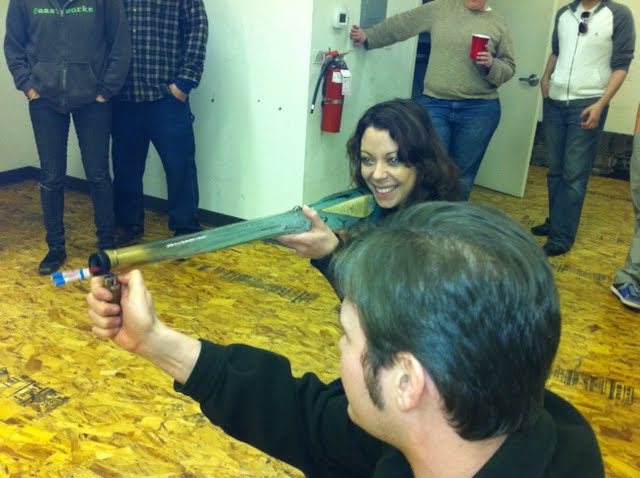
That is a stunning glass musket filled with cheap tequila...and fireworks. What a thoughtful present. Not exactly the type of thing I’m going to take home and mount over the fireplace. We have no choice but to drink the booze tonight and light the fireworks off inside because it's fucking pouring outside. Very,very thoughtful.

And because I thought that things might get a little sloppy, I called the bus to take us around for the evening.

Very sweet bus.

First stop was black light 3-D pirate golf downtown. I got a hole in one.

Back on the bus and off to Spirit of 77. It’s amazing to me that as soon as you show drunk people a brass pole, they feel the need to hang on it like a horny monkey.


After we closed that down, it was back on the bus and off to Radio Cab but not before a brief stop at Voodoo Doughnuts. As far as I know nobody hurled at that point but it might have been a good idea.

The next day, nobody seemed to have a clear idea of what transpired after we got on the bus. We were able to piece it together through corroborated accounts and photos.

The hangovers were impressive and ubiquitous on Tuesday. Nothing like a little mid winter escape to re-energize my staff.

Scott

Thursday, February 17, 2011

After The Rain

I'm fairly new to the west coast. So, foraging for mushrooms is a concept that's new to me as well. While talking with Dave Padberg, our chef de cuisine, he mentioned that it is an annual event for him to make chanterelle vodka with mushrooms that he's foraged himself, here in Oregon. Dave described the vodka as having an earthy and very unique flavor. A vodka good for drinking on the rocks.

A few weeks later, our other bartender, Nic Peterson, had gone chanterelle hunting and had returned with a copious amount of chantrelles, even more then he could use. Nic wanted to infuse vodka with his chantrelle excess, and we did just that.

To begin, you'll want to clean the mushrooms very well. We mixed about 3lbs of chantrelle mushrooms, of any size, that had been halved or quartered, with about 6 liters of vodka. For this recipe, an inexpensive, good quality vodka will do. We use Gordon's.

Let the vodka sit for about 3 weeks. While we let our vodka rest, The chantrelles changed vastly in size. At first, they were so plump they took up more space than the vodka. Eventually, the mushrooms shrank, and continued to shrink. The final state of the mushrooms wasn't the most visually appealing sight, more like a failed science experiment. But, if nothing else it was a great conversation starter.

Once we had our finished product, it was time to start experimenting. When conceptualizing this drink, I wanted to keep it very simple. I wanted the earthy, savory quality of the mushrooms shine through. I thought this vodka really lent itself to a martini style drink. My initial thought was to swap out the vermouth for sake. Many sakes have wonderful qualities that work very well in cocktails. I was hoping to find one that would pair nicely with our vodka. After experimenting with several sakes, I decided that it just wasn't going to work. I went back to basics. I immediately thought of a white martini. A martini that uses the sweeter blanc vermouth, as opposed to regular french or dry vermouth. The result is an extemely savory martini, with the mysterious and unmistakable flavor of chanterelles. The lemon oils expressed over top adds a brightness that makes this drink pop.

After The Rain

1.5 oz Chanterelle infused Vodka
1.5 oz Dolin Blanc Vermouth
Lemon Peel

Combine vodka and vermouth in a mixing glass. Add ice and stir well until the drink is nice and cold. Strain into a chilled martini glass, express the oils from the lemon peel over top of the drink, and discard the lemon peel.

One final note, we only have a few more bottles left so come in and try this cocktail while you still can.

Wednesday, February 2, 2011

Romance at Park Kitchen (?!?!)


Gentle readers, we are rapidly approaching Valentines day. Are you ready? Have you pre-ordered chocolates from Xocolatl de David? Have you decided where in your house you will hide the large bouquet of peonies you got for your honey  (inside the shop-vac!)? Most importantly, have you made reservations for dinner at Park Kitchen yet? They are going fast!
Here is the plan. You will come in and take a seat. Maybe you'll even decide to sit next to each other, you know, for romance.We will start you off with oysters and bubbles. Next you can each choose between chickpea fries or a pomegranate salad with goat cheese and squash. Maybe now it's time for a cocktail? Or just more bubbles. Either way, you'll want something to go along with the evening's special fish preparation or lamb with winter vegetables and truffles. For dessert, there will be panna cotta with blood oranges or devil's food cake with red wine poached pears. A little Sauternes, a little coffee, what's next? Don't tell us.
You also have the option of doing the chef's tasting menu, where you throw your hands in the air and let the chef do all the work. That way you don't have to make any decisions and each dish will be a fun surprise.
You decide which you prefer- the set menu or the chef's choice. They are both $60 a head for the meal and include a delicious glass of bubbles.

Hate romance? Don't worry, we will have our normal menu all weekend. We do, however, anticipate 20% more hand holding at the restaurant over the weekend, and are crossing our fingers for festive Valentines day sweaters. Come in and make our dreams come true.

xoxo, Jenny

Thursday, January 20, 2011

German Wine Tasting Notes

Riesssssliiinnnggg!!!!
I have German and German-style wines on the brain (and in my stomach most of the time) lately. That's why I was extra excited to receive an invitation from Mitchell Wines to attend "Regions of the World- Germany" hosted by Ewald Moseler a few weeks ago. Yesterday was the big day, and oh boy did I have fun. Well, as much fun as you can have in a basement lecture surrounded by other wine dorks. As I mentioned in my last post, Ewald is a German wine importer and all around genius. We tasted ten Rieslings separated into 5 different flights. The first flight was "dry Riesling- focused on ripeness level". In this category the wines were from the same vintage but different regions in Germany- the Mosel and Rheingau. The first was a Kabinett Riesling (meaning it had a light body and was picked when it was just ripe) and the second Spatlese (medium body, harvested when it was a bit riper than Kabinett). What I learned from this flight was that Riesling is not classified by how sweet it is, per se, but instead by how full or lean the body of the wine is. Both of these wines were dry, but the Spatlese had a fuller, softer body than the Kabinett. I was really in love with the Selbach-Oster Kabinett for all of its green apple, blue slate wonder!  How can we get some of that blue slate here in Oregon? I want some for my yard.
Flight #2 was "Dry style Riesling- focused on terroir". The wines were of the same vintage and region in this case, but from very different vineyard sites. I had a hard time wrapping my head around this flight because the wines were so different! It was helpful having a clear example of how terrior really affects wine- on paper it seemed like the wines should taste very similarly but in fact they were worlds apart. Stone, soil, sunlight, micro climate, shade, runoff... the list of variables is astounding. I have so much to learn.
Flight #3 was "traditional Riesling- Kabinett-Spatlese". These two had different weights but similar flavor profiles. Again, it was nice to focus on the texture of the wine and experience sweet wines with beautiful, lemony acidity. I am hoping to help spread the gospel of Riesling. People fear sweet wine- it has a bad reputation. I am about to wedge 2 or 3 of them on our list, and hopefully start turning that reputation around! Rieslings are made to be enjoyed with food!
Flight #4 was nuts. It was called "Rieslings well aged". We tasted a '99 Jos. Christoffel Spatlese and a '93 Jos. Christoffel Auslese. My first sniff of the '99 was memorable. My first instinct was to turn in horror, but mostly I was curious. The wine smelled like a dirty closet that a cat first peed in, and then died in. It was weird, it was bad, but it was interesting. I was nervous to taste it, and I am so glad I did! It tasted like an herb garden, full of honey and flowers. Wow. I don't know what the story behind the nose on that wine was, but I grew to really appreciate it once I tasted the wine it guarded. The '93 on the other hand had a beautiful flowery nose and tasted like dried apricots. Very easy to love.
Flight #5 was dessert wines. Beerenauslese and Eiswein. They were sweet, it's true, but the balance of acidity and ripe fruit was perfect for each of them. The eiswein was brighter and livelier than the beerenauslese, but I almost enjoyed the sweet burn of the beerenauslese more than the perfection of the eiswein...almost.

It is easy to think "Riesling" has only one identity, but in fact it has many. Rieslings can be bone dry, herbal, creamy, rich, or light. They can be wonderful, and yes they can be terrible. You wont  find any of those ones here at Park Kitchen, however. Next time you are in, talk to your server about what we have available... I am imagining a Riesling glass pour in our future....

Wednesday, January 19, 2011

The Future of Fresh Fish

This morning, Scott and I met with Rick Goche, a local fisherman with a family business centered in Coquille, Oregon (near Coos Bay). He has fished albacore and salmon for over twenty years. Since the salmon fishing has become increasingly restricted in Oregon and California in recent years, he is very concerned about maintaining quality with the albacore catch. We were very pleased last year when Provvista Specialty Foods started carrying Rick's albacore loins quick-frozen in vacuum bags. Why would we be excited about frozen fish, you might wonder? Let me explain.


Ever since I moved to Portland in 2002, I have been confounded by the seafood supply here. I was dazzled by our abundance of remarkable farm produce, orchards, vineyards and ranchers raising everything from rabbits and lamb, to beef cattle and buffalo. Yet here, a mere eighty miles from the Pacific Ocean, there was a bleak supply of fresh seafood. Year round, we all see the same limited supply of salmon, halibut, and Yellowfin tuna. Yet these are not fished year round, and rarely from local waters, unless Alaska and Hawaii are to be included in our locale. Most people don't realize that they have been purchasing previously frozen fish for years.


This is not necessarily a bad thing. In the world's largest fish market, where a single Yellowfin tuna can average over $30,000 (a new record set this month was $396,000 for an enormous Bluefin tuna), the frozen-at-sea trade is by far the largest and most consistent way to maintain quality. When a single fish can fetch that much money, you'd better believe they are going to protect their investment. Despite our romantic notions of a fish that has just been pulled from the ocean waters, pristine red gills and deep clear eyes, what more often happens is that it takes a day or two before that "fresh fish" even makes it to the market in Portland. But why? It's not just the ninety minute drive from the coast.

In today's world, seafood can only be considered in the global market. Unfortunately, what this means is that if the currency exchange is better in Japan and China, they will likely buy most of our Dungeness crab, or if the demand for salmon and king crab is greater in Japan than it is in America, they will buy most of Alaska's catch, as they have for decades. Portland is not a big city, and it is not on the coast. It is much easier to deliver large quantities of seafood to San Francisco or Seattle or Vancouver, and that is usually what happens.

This problem is compounded by the ignorance of the consumer. If you go to the fish counter of Whole Foods or New Seasons, you will find far more seafood from the Atlantic than from the Pacific Ocean, if they even bother to label its source. For all of these reasons, the question you should ask when buying "fresh fish" should be how well has it been handled in its fresh and highly perishable, highly vulnerable state. Is it better than that of seafood which has been frozen at the peak of its freshness, and delivered with no further handling damage to its final destination? There are certainly instances where frozen is better, like dense fleshed fish, and rich, oily fish. I'll always take frozen anchovies over fresh, unless I'm buying them on the coast.


Back to our meeting with Rick. Rick is working with Provvista to be proactive about seafood. They are gathering quotes from restaurants to determine how much albacore they might buy this summer. Most of Rick's albacore is canned by his company, Sacred Sea. This is a high quality product, but we'd like to get more fish in the raw. Whether we can get it fresh or frozen, we are trying to find a way to keep the quality high, even when supply is low. I have a feeling that the marketing stigma of frozen fish is going to change in the next few years, and where seafood is concerned, the handling of the product from the ocean to the kitchen will have to be better understood by the consumers.


Keep up the good work Rick,


David

Wednesday, January 12, 2011

Teutonic Wine Company Dinner!

On Friday, January 28th we will be hosting a very special night in our private room at Park Kitchen. The creators of the Teutonic Wine company, Olga and Barnaby Tuttle will be hosting a three-course dinner served with pairings of their own making. We will also be featuring a few wines from German wine importer and expert Ewald Moseler.

Barnaby started his career in wine long ago at Papa Haydn. He started out as a young man washing dishes, then busing, then waiting tables, assistant managing, general managing, and finally buying wine. The day that Ewald brought him in a special collection of German wines was the day that Barnaby realized his future as a wine maker. He knew that he had a passion for German wines, and wanted to try making similar wines in Oregon.

He and Olga first planted 56 chardonnay plants in their back yard in order to experiment with grape growing. They made small amounts of "yard chard" while Barnaby studied up on wine making by reading books and taking classes. In 2005 Olga and Barnaby had the opportunity to plant a vineyard on their friends' land (an old garlic farm) in Alsea, Oregon. The site falls out of the Willamette Valley AVA and is very close to the coast- meaning they would have to work with cold, wet and difficult growing conditions. While some people might not like the sounds of that, these conditions sounded just right for the wines that they loved- lighter styled, mineral-driven wines. They planted 2 acres of Pinot Noir, Pinot Menuier, and Pinot Blanc. In 2008 they had their first commercial sale. Since then, Barnaby and Olga have run the whole show- from working the land and harvesting the grapes to bottling and selling the wines. They work long hours every week, but the wines are exactly as they want them to be.


I had the chance to taste their first vintage at a friends house last year. I had never tasted anything like their '08 Pinot Menuier, and still regret not buying a few bottles to hold on to when they were still available! But the name (and perfect label) stuck in my mind, and when I started buying wine for Park Kitchen in the spring of 2010, their Riesling was one of the first wines I selected. The Park Kitchen staff, as well as Chef Scott and his wife Mary, loved the wine so much that we were able to keep a steady order with Olga and Barnaby.

All of this adds up to one great story, and a story that we want to share with you in more detail at our dinner on the 28th. Come meet Olga, Barnaby and Ewald and try the wines that they, and we, love.

-Jenny

Monday, January 10, 2011

Proud of Our Pork


We take great pride in sourcing our products at Park Kitchen. This will be our third year of buying pork from Chris Roehm at Square Peg Farm in Forest Grove. Chris pulls up in his pick-up truck in front of the restaurant on Wednesday morning, and we carry in a split hog to our wooden six foot work table. Last week's half pig weighed in at one hundred and fifty two pounds (including the head). This is the first pig of Chris' latest breeding cross between Berkshire and Chester. The meat is a proud burgundy red, as good pork should be, and the fat marbling makes this pork worth the premium price we pay for it.


I have a lot of good things to say about the animal husbandry at Square Peg. Chris has some happy pigs on his farm. They have open pasture most of the year, a diet of certified, local organic feed, and something you don't find on many small pig farms these days...piglets! Chris breeds his own pigs rather than simply buying weaners from a commercial breeder. Of course, it's hard work mating and farrowing pigs. He has tried both methods, and found that breeding allows him to keep his animals in a steady and sustainable manner. He has more control over their heritage and their health from beginning to end, and a constant herd of animals keeps his income steady as well. It takes time to build relationships that work for the restaurants demands and the farmers supply. Finding that balance and forming great relationships is worth the wait.


Thanks for everything Chris,


David